The Budget-by-Paycheck Method: How to Plan Every Payday (Step by Step)
If you've ever made a careful monthly budget and still found yourself short a week before payday, the problem might not be your spending. It might be your calendar. Most budget templates assume income arrives once a month. Many people are paid weekly or every two weeks, while rent, utilities and car payments are due on fixed dates. A monthly total can look fine on paper while a single paycheck can't cover the bills that land before the next one.
The budget-by-paycheck method fixes that mismatch by planning each paycheck separately. Instead of asking "can I afford this month?" you ask "what does this paycheck need to cover before the next one arrives?" It's simple, works with any income level and needs nothing more than paper and a calendar.
This article is general education, not personalized financial advice.
Step 1: List every payday for the month
Write down each date you'll be paid and the amount you'll actually take home (after taxes and deductions). If your pay varies — tips, hourly shifts, gig work — use a cautious estimate, ideally the lowest amount you've received recently. You can always assign extra money later; it's much harder to un-spend money you didn't get.
People paid every two weeks will have some months with three paychecks instead of two. Mark those months now. That extra check is one of the best tools you have, and we'll come back to it.
Step 2: List your bills with due dates
Make a list of every fixed bill: rent or mortgage, utilities, phone, insurance, car payment, minimum debt payments, childcare, subscriptions. Next to each, write the due date and the amount. Due dates matter more than totals in this method.
Step 3: Assign each bill to a paycheck
Now match bills to paydays. The rule is straightforward: each bill is paid from the most recent paycheck that arrives before its due date. For example, if you're paid on the 1st and the 15th, a bill due on the 10th comes out of the 1st paycheck, while a bill due on the 20th comes out of the 15th.
If one paycheck ends up overloaded — say, rent and a car payment both fall in the first half of the month — you have a few options:
- Set aside part of the previous paycheck for the big bill.
- Ask the company to move the due date. Many lenders and utilities allow this; it never hurts to ask.
- Split a large bill across two paychecks by saving half in advance.
Step 4: Give the rest of the paycheck a job
After bills, each paycheck still has to cover day-to-day spending: groceries, gas, household basics and kids' needs. Give those categories a set amount per paycheck. Some people use physical cash envelopes; others track "envelopes" on paper while keeping money in the bank. Either works if you write it down.
Then assign whatever remains to goals: an emergency fund, a sinking fund for irregular costs, or extra payments on debt. The aim is a simple equation:
Paycheck − bills − spending − savings − extra debt = $0 left to assign.
Zero doesn't mean your bank account is empty. It means every dollar has a plan before you start spending, which is what stops money from quietly disappearing.
Step 5: Plan for the costs that aren't monthly
Irregular expenses wreck more budgets than emergencies do: school fees, car registration, birthdays, holidays, annual subscriptions, back-to-school clothes. They're predictable — they just don't happen every month.
List them for the year, add them up and divide by the number of paychecks you get. Setting aside that amount every payday into a sinking fund turns a surprise bill into a planned one.
Step 6: Track and check in
The plan only works if you compare it to what actually happens. Jot down spending as you go, and at the end of each pay period ask three questions:
- Did every bill get paid on time?
- Which spending category ran over, and why?
- What will I change for the next paycheck?
A short check-in each payday is more useful than a long review once a year.
When money is tight
If a paycheck can't cover everything, decide in advance what comes first. Many personal-finance educators suggest a priority order like this:
- Food and essential household needs
- Housing (rent or mortgage) and utilities
- Transportation needed to get to work
- Insurance and essential medical needs
- Minimum payments on debts
- Everything else
If you can't pay a bill in full, contact the company before the due date. Many utilities and lenders offer payment plans or hardship programs, and you'll usually have more options if you call early. Free local resources — food banks, utility assistance programs and nonprofit credit counseling — exist for exactly these weeks.
What to do with a "third paycheck" month
If you're paid biweekly, two months a year usually include a third paycheck. Because your regular bills are already covered by the other two, that extra check can go almost entirely toward a goal: a starter emergency fund, a sinking fund for the holidays or a big chunk of a debt. Planning for it ahead of time is one of the easiest wins in the whole method.
Common mistakes to avoid
- Budgeting from gross pay. Always use take-home pay.
- Forgetting small recurring charges. Review a month of bank statements for subscriptions.
- No buffer. Even $20–$50 per paycheck in a "miscellaneous" line prevents one surprise from derailing the plan.
- Giving up after one bad paycheck. The method is a habit, not a test. Adjust and try again on the next payday.
Put it on paper
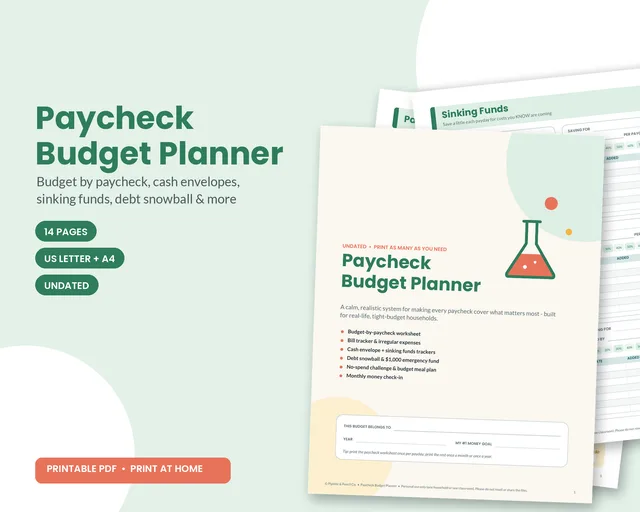
A paycheck budget is easier to stick with when everything is in one place. Our Paycheck Budget Planner walks through these exact steps: an income and paydays page, a 12-month bill tracker, a paycheck budget worksheet with the "left to assign = $0" equation, cash envelope and spending trackers, a sinking funds page, an irregular expenses planner, a debt snowball worksheet and a $1,000 emergency fund tracker. It's 14 undated pages, so you can print fresh copies whenever you need them.
Start with your next paycheck. List the date, the bills it has to cover and the amount left over. That single page is a budget — and it's one that actually matches the way you get paid.