How to Memorize Polyatomic Ions (Without Memorizing Them All)
Polyatomic ions are one of the first real hurdles in high school and intro college chemistry. Suddenly there's a list of twenty-plus names, formulas and charges to learn, and every naming and equation problem depends on them. The good news: you don't have to memorize the whole list as separate facts. Learn a small core set, learn a few patterns, and most of the rest can be worked out.
What is a polyatomic ion?
A polyatomic ion is a group of atoms bonded together that carries an overall charge and acts as a single unit. In a compound like sodium nitrate, NaNO₃, the NO₃⁻ group stays together — it's one ion, nitrate, paired with the sodium ion Na⁺. When there's more than one of a polyatomic ion in a formula, it goes in parentheses: calcium nitrate is Ca(NO₃)₂.
Step 1: Learn the core "-ate" ions first
Most of the common polyatomic ions are built from a handful of "-ate" ions. Learn these first, with their charges:
| Ion | Formula | Charge |
|---|---|---|
| Nitrate | NO₃⁻ | −1 |
| Chlorate | ClO₃⁻ | −1 |
| Carbonate | CO₃²⁻ | −2 |
| Sulfate | SO₄²⁻ | −2 |
| Phosphate | PO₄³⁻ | −3 |
A popular memory trick uses the nonsense phrase "Nick the Camel ate a Clam for Supper in Phoenix." The number of consonants in each key word gives the number of oxygens, and the number of vowels gives the charge:
- Nick → Nitrate: 3 consonants (N, c, k) → 3 oxygens; 1 vowel (i) → −1 → NO₃⁻
- Camel → Carbonate: 3 consonants → 3 oxygens; 2 vowels → −2 → CO₃²⁻
- Clam → Chlorate: 3 consonants → 3 oxygens; 1 vowel → −1 → ClO₃⁻
- Supper → Sulfate: 4 consonants → 4 oxygens; 2 vowels → −2 → SO₄²⁻
- Phoenix → Phosphate: 4 consonants → 4 oxygens; 3 vowels → −3 → PO₄³⁻
(For "Phoenix," count P, h, n, x as consonants and o, e, i as vowels.) It's silly, which is exactly why it sticks.
Step 2: Use "-ite" to remove one oxygen
Here's the first pattern that multiplies what you know. The "-ite" version of an ion has one fewer oxygen and the same charge:
- Nitrate NO₃⁻ → nitrite NO₂⁻
- Sulfate SO₄²⁻ → sulfite SO₃²⁻
- Chlorate ClO₃⁻ → chlorite ClO₂⁻
- Phosphate PO₄³⁻ → phosphite PO₃³⁻
Learn five, get five more free.
Step 3: Use "per-" and "hypo-" for the halogen series
For chlorine (and the other halogens bromine and iodine) there's a four-member family. Start from chlorate and add or remove oxygens:
| Name | Formula | Rule |
|---|---|---|
| Perchlorate | ClO₄⁻ | per-…-ate: one more O than -ate |
| Chlorate | ClO₃⁻ | the base -ate ion |
| Chlorite | ClO₂⁻ | -ite: one fewer O |
| Hypochlorite | ClO⁻ | hypo-…-ite: two fewer O |
The charge stays −1 throughout. Swap Cl for Br or I and the same pattern gives you bromate (BrO₃⁻), iodate (IO₃⁻) and so on.
Step 4: Add hydrogen to reduce the charge
Adding a hydrogen ion (H⁺) to a negative polyatomic ion makes the charge one step less negative, and the name gains "hydrogen" (or the older prefix "bi-"):
- Carbonate CO₃²⁻ → hydrogen carbonate (bicarbonate) HCO₃⁻
- Sulfate SO₄²⁻ → hydrogen sulfate (bisulfate) HSO₄⁻
- Phosphate PO₄³⁻ → hydrogen phosphate HPO₄²⁻ → dihydrogen phosphate H₂PO₄⁻
Step 5: Memorize the few that don't follow the pattern
A small group simply has to be learned on its own. Most courses expect at least these:
- Ammonium, NH₄⁺ — one of the few common positive polyatomic ions
- Hydroxide, OH⁻
- Cyanide, CN⁻
- Acetate, C₂H₃O₂⁻ (also written CH₃COO⁻)
- Permanganate, MnO₄⁻
- Chromate, CrO₄²⁻ and dichromate, Cr₂O₇²⁻
- Peroxide, O₂²⁻
Check your teacher's or textbook's list — courses vary in which ions they require.
How to study them so they stick
Use active recall, not rereading. Cover the formulas and try to write them from the names, then reverse it. Reading a list feels productive but doesn't build memory the way retrieval practice does.
Space it out. Ten minutes a day for a week beats a single hour the night before the test. Each session, start with the ions you missed last time.
Make flashcards with the name on one side only. Write the formula and charge on the back. Forgetting the charge is the most common mistake, and it breaks every formula you write afterward.
Practice in context. Once you know a few ions, write formulas for compounds: sodium sulfate (Na₂SO₄), ammonium phosphate ((NH₄)₃PO₄), calcium hydroxide (Ca(OH)₂). Balancing the charges forces you to remember them.
Teach it. Explain the -ate/-ite rule to a friend or family member. If you can explain it, you understand it.
Common mistakes to watch for
- Forgetting parentheses: write Ca(OH)₂, not CaOH₂.
- Mixing up sulfate and sulfite, or nitrate and nitrite — use the "-ite has one less O" rule to check.
- Dropping the charge on hydrogen-containing ions: bicarbonate is −1, not −2.
- Changing the subscripts inside a polyatomic ion to balance a formula. Never do that — adjust how many ions you have instead.
A one-page reference helps
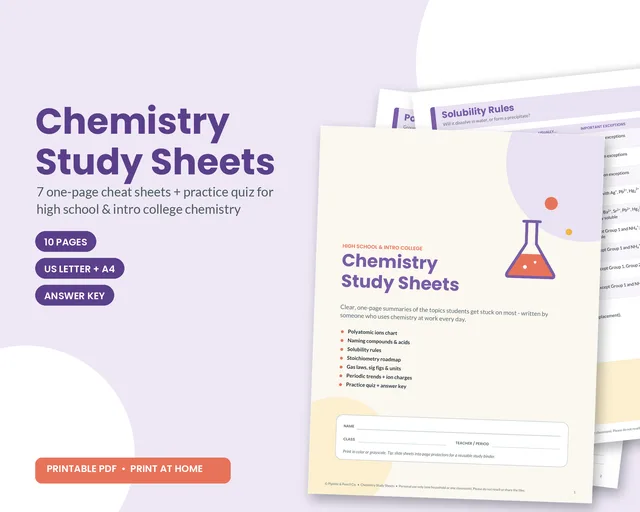
Patterns are easier to see when everything is on one page. Our Chemistry Study Sheets start with a Polyatomic Ions chart — 27 common ions grouped by charge, with the -ate/-ite/per-/hypo- naming patterns laid out — followed by sheets on naming compounds, solubility rules, stoichiometry, gas laws, sig figs and periodic trends, plus a 24-question practice quiz with an answer key.
Start with the five "-ate" ions this week. Once those are solid, the patterns do most of the remaining work for you.