10 Easy Kitchen Science Experiments for Kids (With the Science Explained)
You don't need a lab, a kit or a big budget to do real science with kids. A kitchen already has acids, bases, solutions, gases and enough water to explore for weeks. The trick is to move beyond "wow" and into "why" — asking kids what they think will happen, watching closely and then talking about the reason.
Below are ten easy experiments that use common household ingredients. Each one includes a short, kid-friendly explanation. An adult should supervise every experiment, and anything involving hot water, the stove or a sharp tool should be handled by a grown-up.
Before you start: a simple routine
Turn each experiment into a mini scientific method:
- Predict. "What do you think will happen?" Write or draw it.
- Do it. Follow the steps together.
- Observe. What did you see, hear or smell?
- Explain. Talk through the science.
- Change one thing. Try again with a single change and compare.
That last step is where real science thinking happens — kids learn what a variable is without ever needing the word.
1. Fizzing volcano
You need: baking soda, vinegar, a cup or bottle, a tray, optional dish soap and food coloring.
Put a few spoonfuls of baking soda in the cup on a tray. Add a squirt of dish soap and coloring, then pour in vinegar.
What's happening: Vinegar is an acid and baking soda is a base. When they react, they produce carbon dioxide gas. The bubbles get trapped in the soap, making foam that overflows.
Try this: Does warm vinegar fizz faster than cold?
2. Dancing raisins
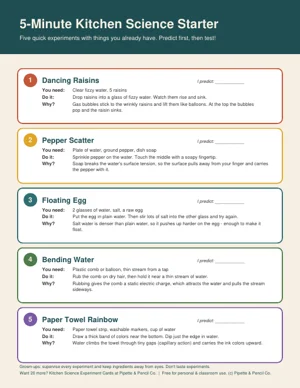
You need: a clear glass, clear fizzy water or soda, a few raisins.
Drop raisins into the fizzy drink and watch.
What's happening: Gas bubbles cling to the wrinkly raisin surface and lift it like tiny balloons. At the top, the bubbles pop and the raisin sinks again.
3. Rainbow milk
You need: a shallow plate, whole milk, food coloring, dish soap, a cotton swab.
Pour milk onto the plate, add drops of color, then touch the center with a soapy swab.
What's happening: Soap breaks the surface tension of the milk and interacts with its fat, so the surface pulls away and the colors swirl outward.
4. Walking water
You need: three to five clear cups, water, food coloring, paper towels.
Fill alternating cups with colored water. Fold paper towel strips to bridge each cup to the next and wait an hour or more.
What's happening: Water travels up the paper towel through tiny gaps between fibers — this is called capillary action. The colors mix in the empty cups.
5. Cabbage color detective
You need: red cabbage, hot water (grown-up job), clear cups, testing liquids such as vinegar, lemon juice and a baking soda solution.
An adult chops cabbage and covers it with hot water. Once cooled, strain the purple liquid into cups and add different test liquids.
What's happening: Red cabbage contains natural pigments that change color depending on whether something is an acid or a base. Acids tend to turn it pink or red; bases push it toward green or blue. You've made a homemade pH indicator.
6. Secret lemon ink
You need: lemon juice, a cotton swab, white paper, a heat source handled by an adult (such as a warm iron or a light bulb's warmth).
Write a message with lemon juice and let it dry. An adult gently warms the paper.
What's happening: Lemon juice weakens and changes the paper where it was applied, so those areas brown faster than the rest when warmed.
7. Oobleck
You need: cornstarch, water, a bowl, a tray.
Mix about two parts cornstarch to one part water. Punch it, then let your fingers sink in slowly.
What's happening: Oobleck is a non-Newtonian fluid. Squeeze or hit it and it acts like a solid; relax and it flows like a liquid. (Tip: don't pour it down the drain — let it dry and throw it in the trash.)
8. Floating egg
You need: two tall glasses, water, salt, a raw egg.
Place the egg in plain water, then in very salty water.
What's happening: Salt water is denser than fresh water. When the water is dense enough, it pushes up on the egg with enough force to float it.
9. Self-inflating balloon
You need: a balloon, a small bottle, baking soda, vinegar, a funnel.
Put vinegar in the bottle and baking soda in the balloon. Stretch the balloon over the bottle's mouth, then tip the baking soda in.
What's happening: The same acid-base reaction from the volcano makes carbon dioxide, which has nowhere to go but into the balloon.
Try this: Does more baking soda make a bigger balloon? Measure to find out.
10. Coffee filter chromatography
You need: a coffee filter, washable markers (non-permanent), a cup of shallow water.
Draw a thick dot near the bottom of a filter strip and dip just the edge in water, keeping the dot above the waterline.
What's happening: Many marker colors are mixtures of different dyes. As water travels up the filter, each dye moves at a different speed, separating into bands. Scientists use a similar idea, called chromatography, to separate mixtures.
Safety and mess tips
- Work on a tray or a baking sheet to contain spills.
- Keep ingredients out of eyes; have kids wash hands afterward.
- Never taste experiments unless they're designed to be food.
- Grown-ups handle heat, hot water and anything sharp.
- Use food coloring sparingly — it stains fabric and grout.
How to keep kids interested
Kids love collecting. A simple tracker where they color a star for each experiment turns ten activities into a goal. Asking them to explain the result to another family member is also a great way to check understanding — if they can teach it, they've learned it.
Get all 20 experiments as printable cards
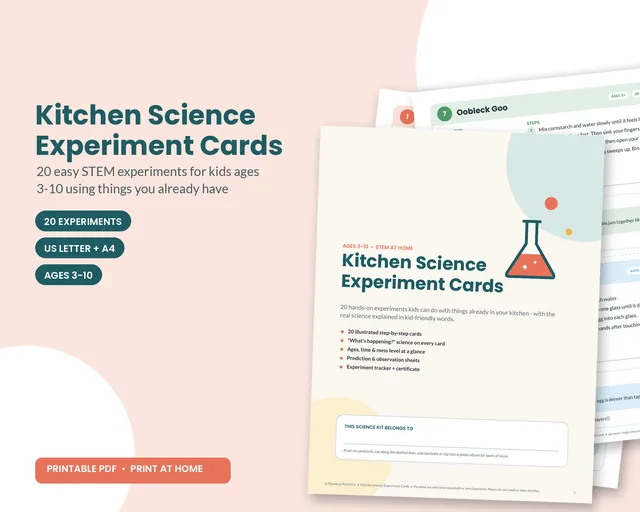
If you'd rather not search for instructions each time, our Kitchen Science Experiment Cards collect 20 experiments — including all ten above — on printable cards with ages, time and mess level at a glance, a "you need" checklist, simple steps, an "I predict…" space, a kid-friendly science explanation and a "try this!" extension. The pack also includes a grown-up safety page, an observation sheet, an "experiments I've tried" tracker and a junior scientist certificate.
Pick one experiment this weekend, ask "what do you think will happen?" and let your kitchen become the lab.