Visual Routines for Kids: How to Make a Picture Schedule That Actually Works
"Shoes on. Shoes. Your shoes." If mornings in your house sound like a broken record, you're in very good company. Young children often struggle to hold a sequence of steps in their heads, especially when they're tired, distracted or excited. A visual routine chart — a sequence of pictures showing what comes next — moves that sequence out of your voice and onto the wall, where your child can check it on their own.
Visual schedules are widely used in preschools, kindergarten classrooms and by occupational therapists and special-education teachers, and many families find them helpful at home for children with and without ADHD or autism. They're not magic, but they can make daily transitions calmer and help kids build independence one small step at a time.
If you have concerns about your child's development or behavior, your pediatrician or a qualified specialist is the right person to talk to. This article shares general, practical ideas for home routines.
Why pictures help
Pictures work for kids who can't read yet, and they're faster to scan for kids who can. A chart also changes the dynamic: instead of a parent telling a child what to do next, the child checks the chart. "What does your chart say comes after breakfast?" is a question, not a command, and it hands the child a little control.
Routines also help because they're predictable. When the same steps happen in the same order every day, kids spend less energy wondering what's coming and resisting the unknown.
Step 1: Pick one routine to start
Don't launch morning, after-school and bedtime charts on the same day. Pick the routine that causes the most friction — for many families, that's the morning rush or bedtime — and start there. Add another only once the first feels normal.
Step 2: Break it into small, concrete steps
Walk through the routine yourself and list each step in order. Be concrete. "Get ready" is too vague; "get dressed," "brush teeth," "shoes on" are steps a child can picture and finish.
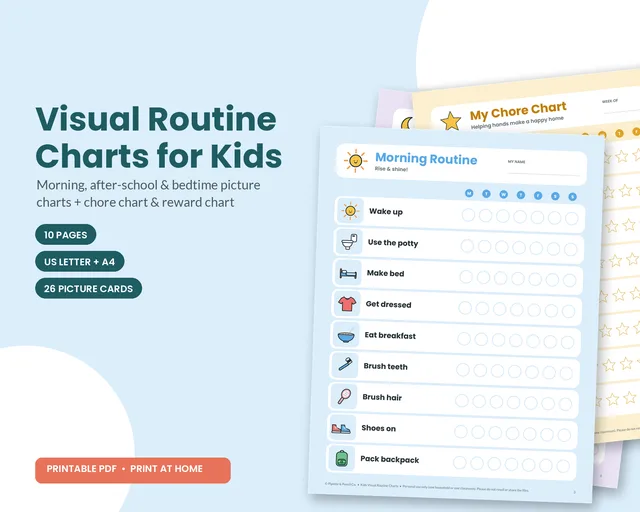
A typical morning routine might be:
- Use the bathroom
- Get dressed
- Eat breakfast
- Brush teeth
- Brush hair
- Shoes on
- Backpack and coat
For younger children, keep it to about three to five steps at first. Older children can handle more. You can always add steps later.
Step 3: Match each step to a clear picture
Use simple, consistent images — one action per picture. Photos of your own child doing each step work beautifully; so do clean illustrated picture cards. Put them in the order they happen, top to bottom or left to right.
Step 4: Make it interactive
Kids engage more with a chart they can do something with. Options include:
- A check-off circle next to each step, marked with a dry-erase marker on a laminated chart
- Picture cards attached with hook-and-loop dots that move to a "done" column
- A star or sticker for each completed step
The physical act of checking off a step gives a small sense of accomplishment.
Step 5: Introduce it at a calm time
Show your child the chart when nobody is rushing — a weekend afternoon, not five minutes before the bus. Walk through it together, let them help decide where it hangs and maybe practice the steps as a game. Children are more likely to use something they've helped create.
Step 6: Point to the chart instead of repeating yourself
This is the habit that makes the biggest difference — for the parent. When your child stalls, resist the urge to list the next five steps. Instead, point to the chart or ask, "What's next on your chart?" Over time, the chart becomes the reminder and you become the coach.
Using a First/Then board for tricky transitions
Some moments are harder than a whole routine — turning off a screen, leaving the playground, starting homework. A First/Then board shows just two pictures: first the less-preferred task, then something the child is looking forward to. "First shoes, then park." It's simple, concrete and easy for young children to understand.
Keep the "then" reasonable and immediate — a favorite song in the car or five minutes of play, not a big prize.
Should you use rewards?
Many families pair routine charts with a reward chart: fill a row of stars, earn a small agreed-upon reward. This can help get a new routine started. Keep rewards small and focus your praise on the effort ("You remembered your backpack all by yourself!"). As the routine becomes automatic, you can gradually fade the rewards while keeping the chart.
Troubleshooting
"My child ignores the chart." Make sure it's at their eye level and in the spot where the routine happens — a bedtime chart near the bathroom, a morning chart by the door. Then make checking it part of the routine itself.
"It worked for a week, then stopped." That's normal. Refresh it: let your child pick a new marker color, move the chart or add a fun final step ("pick a song for the car").
"We have different routines on different days." Use movable picture cards, or create a separate chart for school days and weekends.
"Siblings fight over it." Give each child their own chart, even if the steps are the same.
Printable charts make it easy
You can draw a routine chart by hand, but printable templates save time and look consistent. Our Kids Visual Routine Charts include ready-made morning (9 steps), after-school (7 steps) and bedtime (9 steps) charts with Monday-to-Sunday check-off circles, a weekly chore chart, a 30-star reward chart, a First/Then board and 26 picture cards plus blank cards for building your own routine. Print on cardstock, laminate or slide into a sheet protector, and check off with a dry-erase marker.
Start with one routine and a handful of steps. The goal isn't a perfect morning — it's a child who can look at the wall and know what comes next.